
SEIM Analytics analyzes the causes of international and intrastate conflicts, and joins mediation and dialogue facilitation teams in order to look for ways to resolve them. SEIM Analytics offers applied advisory services and risk assessments on political stability and security in Eastern Europe and the Balkans.
Clients are foreign ministries, policymakers, security agencies, defense professionals, investors, media, international organizations, the research sector, or interested individuals.
SEIM Political Advisory: Gain Insight – Act With Confidence - Click to schedule a lecture or consultation!
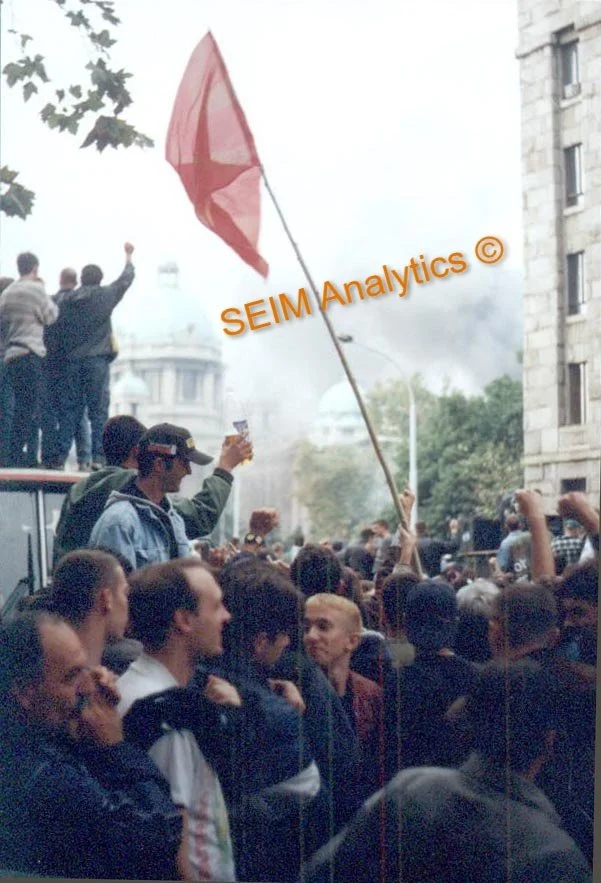
Photo: Seim observing the velvet revolution in Belgrade on 5 October 2000 with the storming and burning of the parliament and TV-building.
Geopolitical analysis and monitoring of military & ethnic conflicts
Services and fields of expertise:
Analysis of the war in Ukraine (daily/weekly updates of the military developments at the frontlines and of the geopolitical environment)
Russia’s foreign policy & Russia’s energy policies
Political analysis and security trends of the Western Balkans (emphasis on Bosnia & Herzegovina, Serbia and Kosovo, North Makedonia, Montenegro, and Croatia)
Human rights, minority rights, and ethnic relations in the Balkans
The stalled EU enlargement process on the Western Balkans
Tailored assessments and conflict analysis of the Middle East, Central Asia, and South Asia (Myanmar, Sri Lanka).
Click on boxes for more detailed info on states and regions of professional interest and competence of SEIM Analytics:
Conflict and geopolitical prediction:
As a geopolitical analyst and PhD in conflict studies, Seim seeks to forecast military conflict scenarios and geopolitical outcomes correctly.
SEIM Analytics provides early-warning insights into political instability, conflict trajectories, and regime shifts — enabling clients to act and navigate, not react. Predicting conflict trajectories is a key to design political partnerships and to handle investment portfolios. SEIM Analytics assist clients in understanding risks associated with political upheavals and conflicts.
Our forecasting seeks to support decision-making, diplomacy, negotiation opportunities, and investment planning.
SOME EXAMPLES:
The war in Donbas 2014-15: Predicted the military survival and Aug/Sept 2014 counteroffensive of Donetsk-Luhansk militias on Twitter. Thereafter, Jan 2015: Predicted the Debaltsevo battle and its outcome in job interview for OSCE.
The war in Ukraine> X: 25. Feb. 2022 : “Kyiv battles, a distraction from the real strategic military moves in the South. Russian capture of Kakovka dam and Melitopol opens the South. From Melitopol possible northward push on Zaporizhija and eastwards on Mariupol & Volnovakha = attack Ukrainian Maginot line from the rear.”
The war in Ukraine turning : January 2023, after the battle for Soledar in Donbas: “The war has turned in Russian favor.”
& “Russia only to advance and achieve territorial gains in Ukraine” (Voiced at a seminar at Vienna University organized by newspaper Die Furche on 21 February 2024).
10 August 2025: “In the autumn of 2025, Russia has good prospects of encircling and capturing Konstantinivka, Kupiansk, and Pokrovsk if no ceasefire is reached through Putin’s meetings with Trump.” (Source: verifiable research application)
Military coup d'état possibilities in Myanmar (flagged 16 August 2020 in internal reporting within The Carter Center IEOM). Coup took place 1 February 2021 before the new parliament was set to convene. This coup was costly to the Norwegian Telenor Telecommunication company, for instance.
Two articles in Norwegian newspapers in March 2011 being critical to Western (including Norwegian) bombing of Libya. See Stormaktenes interesser, in Dagbladet 24 March, and Déjà-vu i Libya, Bergens Tidende, 27 March.
Assad to remain in power (predicted both in 2011 when Russia stepped in and after the Hezbollah-supported conquest of the strategical town of al-Qusayr, southwest of Homs, west of Damascus. See Seim’s articles on the proxy war in Syria and Libya. More Syria-analyses on X/Twitter.
Predicting NATO bombing of FRY, therefore leaving Belgrade as a student one day ahead of the NATO bombing 23.03.1999, being informed by own local Serbian newspaper analysis.
Western recognition of Kosovo as independent in February 2008 to have repercussions elsewhere, e.g. South Caucasus (Georgia) later. See analysis in Danish newspaper Information : “Kosovo is not unique, but in the longer term, Kosovo’s status may influence a number of frozen conflicts in Eastern Europe. It could be used in the conflict management of Abkhazia, South Ossetia, and Nagorno-Karabakh in the Caucasus, the Trans-Dniester Republic in Moldova, the Kurdish question, and be referred to by the Russian minorities in Estonia and Ukraine.” (...) “Russia will veto Kosovo’s admission to the UN and may consider recognizing similar breakaway regions in the Caucasus as a countermeasure. A conflict in South Ossetia in Georgia...”
Assessing Trump’s tariff war in April 2025 as his poker playing. SEIM Investments bought the dip back then, but sold too early later. SEIM Global Investments had a 15 % portfolio increase in 2025.
The Iran-bombing in 2025 as choreographed and scripted.
A key principle for Seim’s analysis of Russia and the conflict regarding Ukraine is simply to listen to Russia, to Putin, and to foreign minister Lavrov. This made SEIM predict Russian policies and behaviour for more than a decade. This is a lesson Western politicians should have learnt already after the Munich Security Conference in 2008.
Polymarket | The World's Largest Prediction Market
Click for SEIMs prediction results TABLE (page under construction)
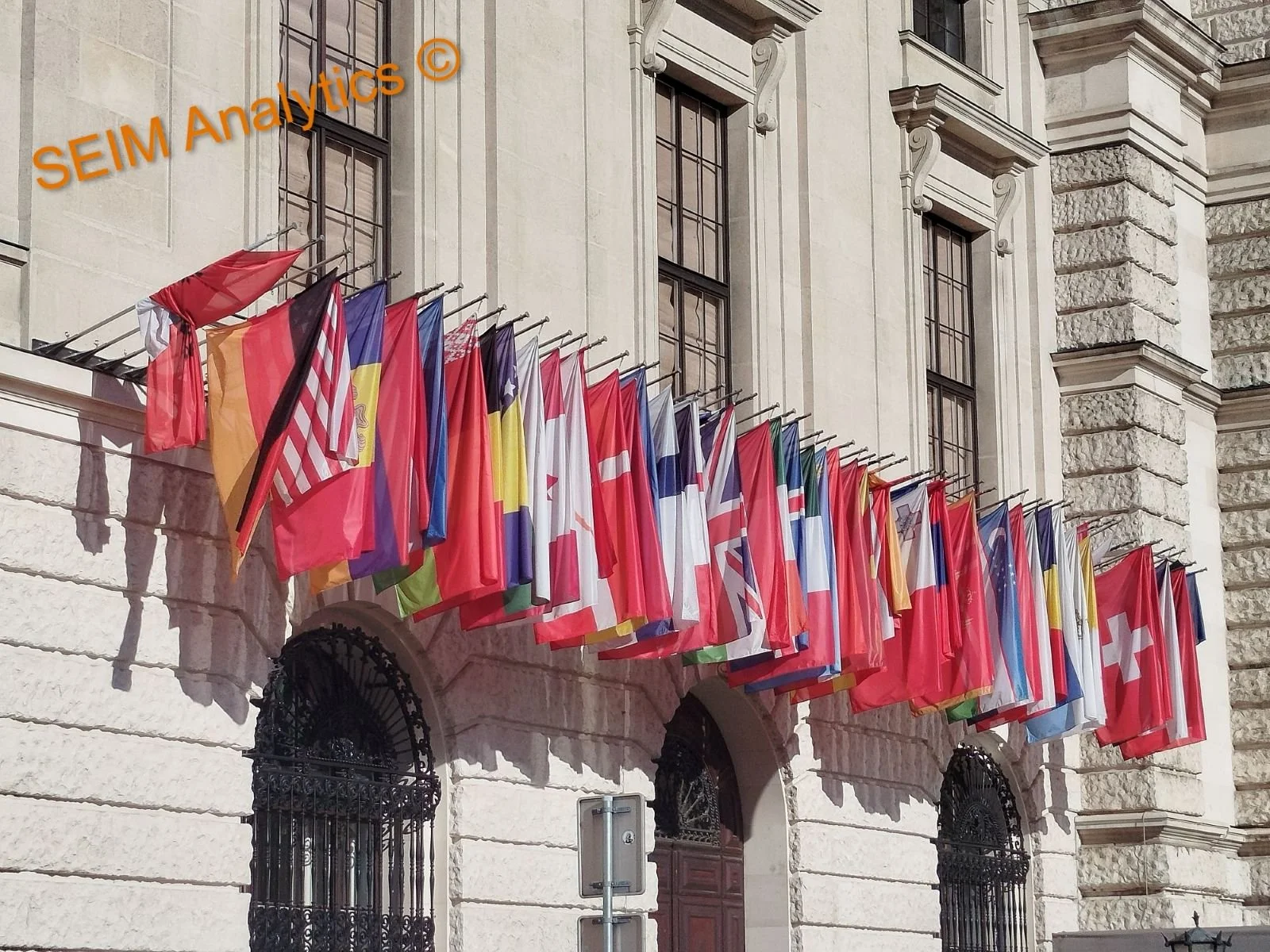
OSCE’s member state flags at Hofburg in Vienna