
The Asian Century and Asian security challenges:
25 November 2025
EVENT REPORTS AND ANALYSIS
SEIM Analytics participated on 24 November 2025 at the public event Europe and Southeast Asia: Anchors For a Stable Indo-Pacific Order that took place at Diplomatic Academy in Vienna. See the AIES-organized panel discussion event on Youtube here! The event had particular relevance for the Myanmar focus of SEIM Analytics.
(See also a report below from the Asias security talk on 21 October of Huong Le Thu, Deputy Director of the Asia Program of the International Crisis Group)
This event interest comes on top of Dr. Seim recently successfully finishing a consultancy project with European Union (EEAS) as seconded analyst of elections and politics in the Eastern Province of Sri Lanka in October 2024. Moreover, Dr. Seim worked for six months as Political & Campaign & Inclusion Analyst for The Carter Center in/on Myanmar in 2020-21 before the military coup. For an overview of the main and most recent engagements of SEIM Analytics with ASIA, click here!
EUROPE’S STRATEGIC CONSTRAINTS IN SOUTHEAST ASIA:
A key topic was Europe’s role in Southeast Asia amidst the structural US-China competition. Europe is courted by both. Although the United States remains an obvious preference, Europe also wants to keep its autonomy in its relationship to the Indo-Pacific states. Yet, due to EUs weaknesses, this autonomy is contingent and Europe is both a player and a playground for them. Currently, as one event speaker claimed, EU or Europe is not assertive about nor thinking clearly enough about its spheres of influences. Rare earth minerals access is a key issue where China with its dominant position in processing can blackmail Europe through its supply-chain vulnerabilities. The rare earth value chain is fundamental for EU and Europe to be competitive in advanced technological industrial production, but Europe’s green energy policies is hindering such mining in Europe despite competition for it intensifying.
Challenges to EU’s influence in Asia: Fragmentation and internal divides in Europe is hampering the formulation of more efficient policies or a restructuring of EU decision making procedures, it was pinpointed. The position and potential role of the United Kingdom and of Australia in Asia was also discussed. As EU is limited in Asia and cannot project power independently in the region in a meaningful manner, lacking tools and intelligence, it should not forget its potential partnership in these two countries. One EU tool is soft power, SEIM Analytics asserts, the election observation missions in Asia of EUs External Action Service (EEAS) is one of such tools, one Dr. Seim has worked with on two occasions, in Sri Lanka and Bangladesh.
MYANMAR:
The event also presented the case-study of Myanmar, which is of particular interest to SEIM Analytics, after six months of work there for the Carter Center in 2020 before the military coup 1 February 2021. A Myanmar research group at the University of Olomouc in Czechia was established in 2024. See also the associated Myanmar Coup Tracker and the EU-supported project "The EU in the volatile Indo-Pacific region.”
Regarding Myanmar, although ASEAN is often mentioned critically because of its lacking critique of the Myanmar coup makers, it is important to keep in mind that ASEAN is a very informal organization, which makes such idealistic criticism impossible. EU seems to have quickly forgotten Myanmar, it was asserted by representatives of the Olomouc Research Group, despite millions being in need of humanitarian assistance. Also, the repatriation of the Rohingyas seems impossible due to the role of the Arakan Army in the Rakhine Province. A policy suggestion of the Olomouc University Myanmar Research Group is for EU to support parallel governance structures in the territories outside control of the military regime in Myanmar and to recognize or at least make contacts with the political stakeholders in rebel areas, to not exclude ethnic voices. The urgent needs in Myanmar have multiplied after USAiD left. While EU is passive in Myanmar, China is influential there, being able to play multiple sides.
The lack of knowledge about Myanmar hinders proper engagement with Myanmar, it was assessed. Indeed, Dr. Seim agrees: Myanmar is a highly complicated country with some 135 ethnic groups and perpetual civil wars since the late 1940s and 1950s (first the Karen National Union was rebelling from January 1949, while in the 1950s and 1960s the Shan, Kachin, Mon, Chin, Rakhine groups began organizing armed movements). SEIM Analytics here offers assistance with own expertise and in-field experiences. Contact SEIM Analytics for analytical guidance on South Asian geopolitics, risk and conflict analysis, and assessments of electoral/political developments.
ASIAN SECURITY CHALLENGES
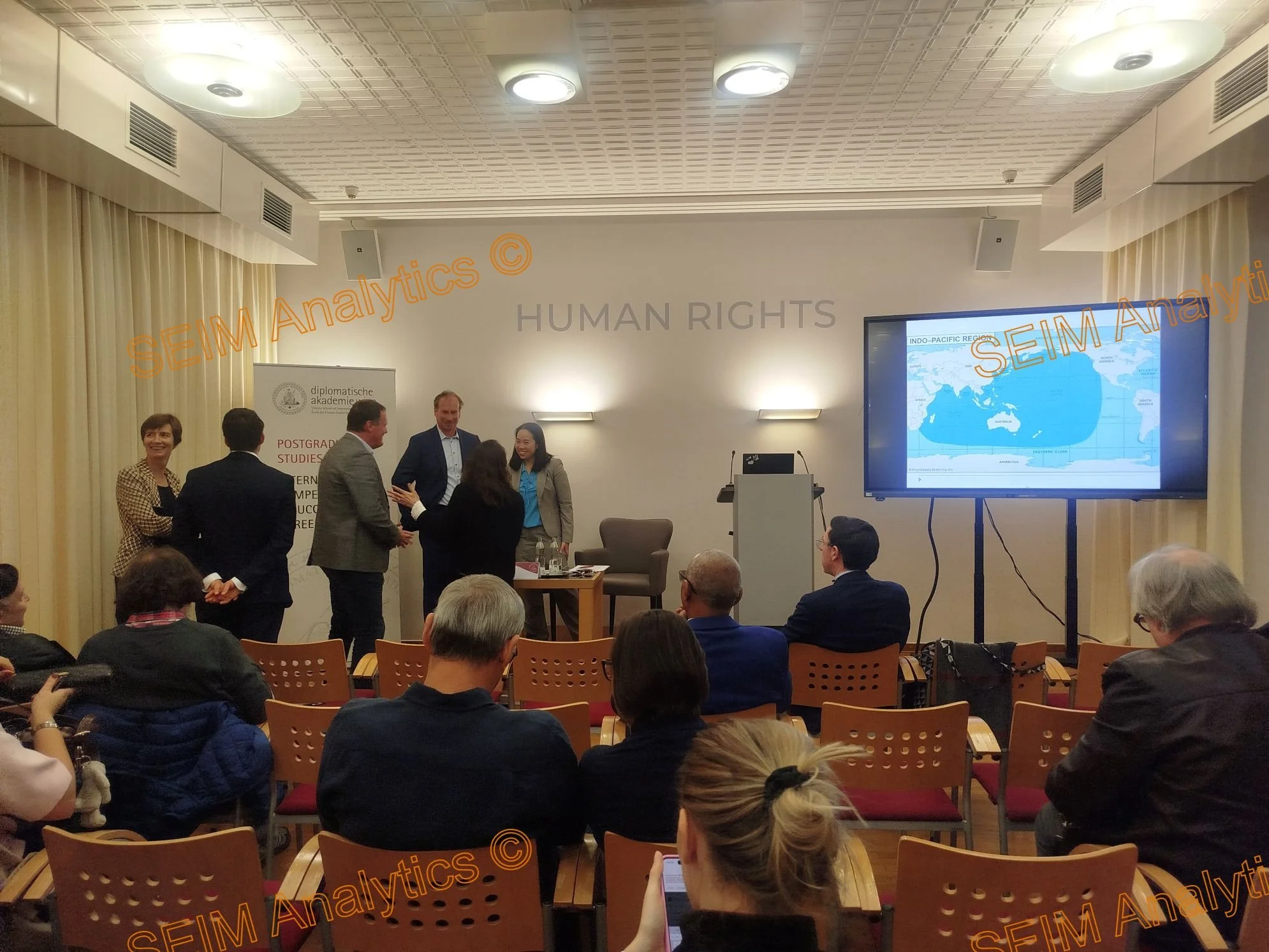
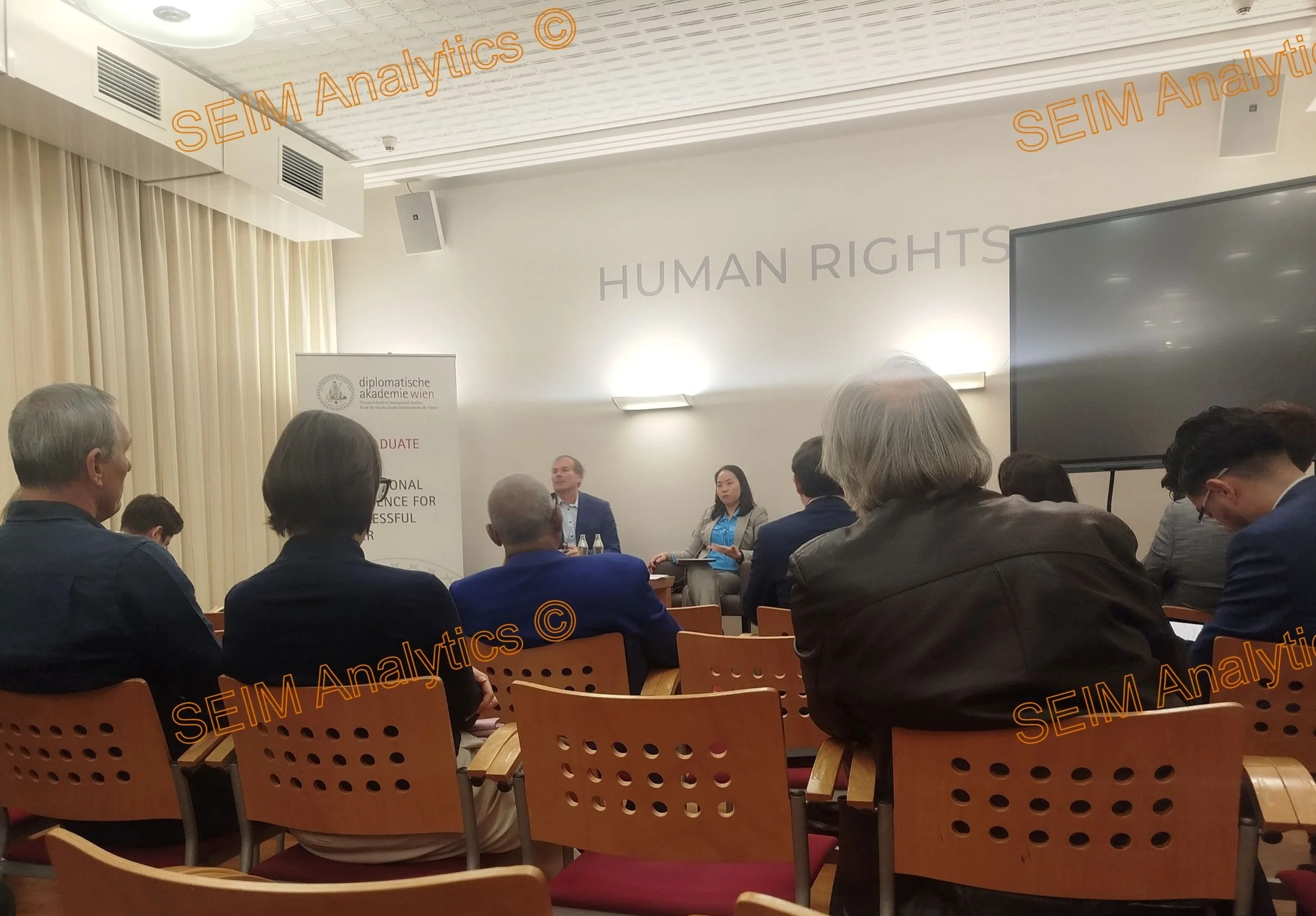
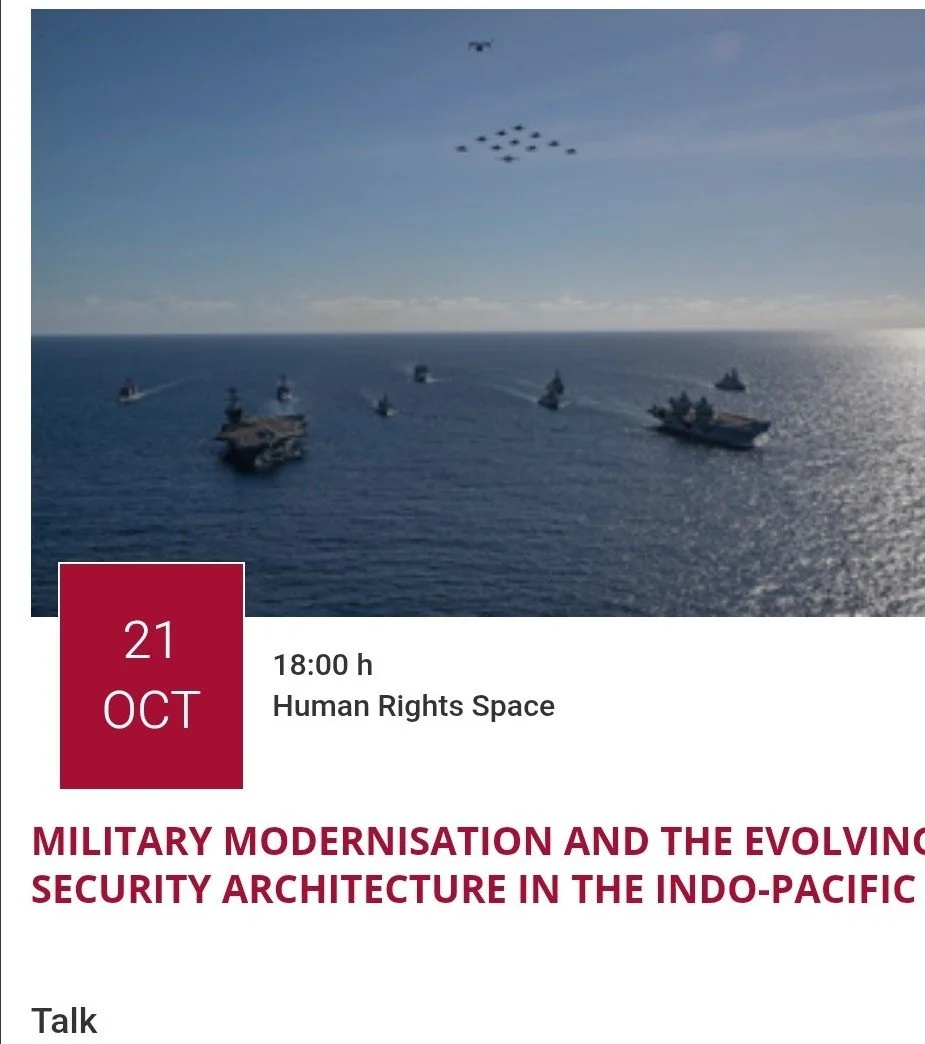
On 21 October 2025, SEIM Analytics also participated at Military Modernisation and the Evolving Security Architecture in the Indo-Pacific - a talk at the Diplomatic Academy in Vienna given by Huong Le Thu, Deputy Director of the Asia Program of the International Crisis Group.
A topic or assertion raised by the organizer was if the future world order will be decided in Asia. Another challenge Huong Le Thu was asked about was how EU can help strengthen a multilateral rules-based order in the Indo-Pacific, especially regarding the South China Sea dispute amidst free trade threats and Sino-US rivalries. In the South Sea, China is claiming major parts of the Chinese South Sea, yet the Philippines, Vietnam, Malaysia, Taiwan, and Brunei are also claiming overlapping zones. The area has seen increasing militarization, including at artificially-built or extended islands. The Philippines, where the United States have military bases, is projected to be important in the event of an escalation regarding Taiwan and/or the South China Sea. Chinese red lines emanate from the Taiwan question, which it views as an integral part of China. But China is wary of its regional and global image, and is treating Taiwan accordingly, SEIM Analytics judges. China looks to the treatment of Russia and the war in Ukraine to assess its scope of possibilities.
Another actor, Japan, for its part fields a modern and increasingly capable military, able to conduct more than purely self-defensive or pre-emptive operations. Nevertheless, Tokyo continues to prefer a regional leadership role grounded in diplomacy, conflict-prevention, and development initiatives across Asia—including engagement in Myanmar. Meanwhile, the precarious Pakistan-Indian truce remains a key underlying conflict. Also, the Thai-Cambodian conflict is worrying.
What can be concluded from the interactive talk of Huong Le Thu is that Asia remains a dynamic region in flux, but that the Asian century we are in now should not be confused with Asian calm. There are a range of potential hotspots in Asia, and actors have diverse interests. Increasing militarization, however, is still not an arms race. Expansion of deterrence options must avoid escalating tensions. How to solve the question about Taiwan remains a key concern.
SEIM Analytics hopes to continue building its India, China, and South Asia portfolio and to take on engagements for clients! Read more about the Asia portfolio at SEIM-Analytics.com/asia