
EU and the Western Balkans
2 February 2025
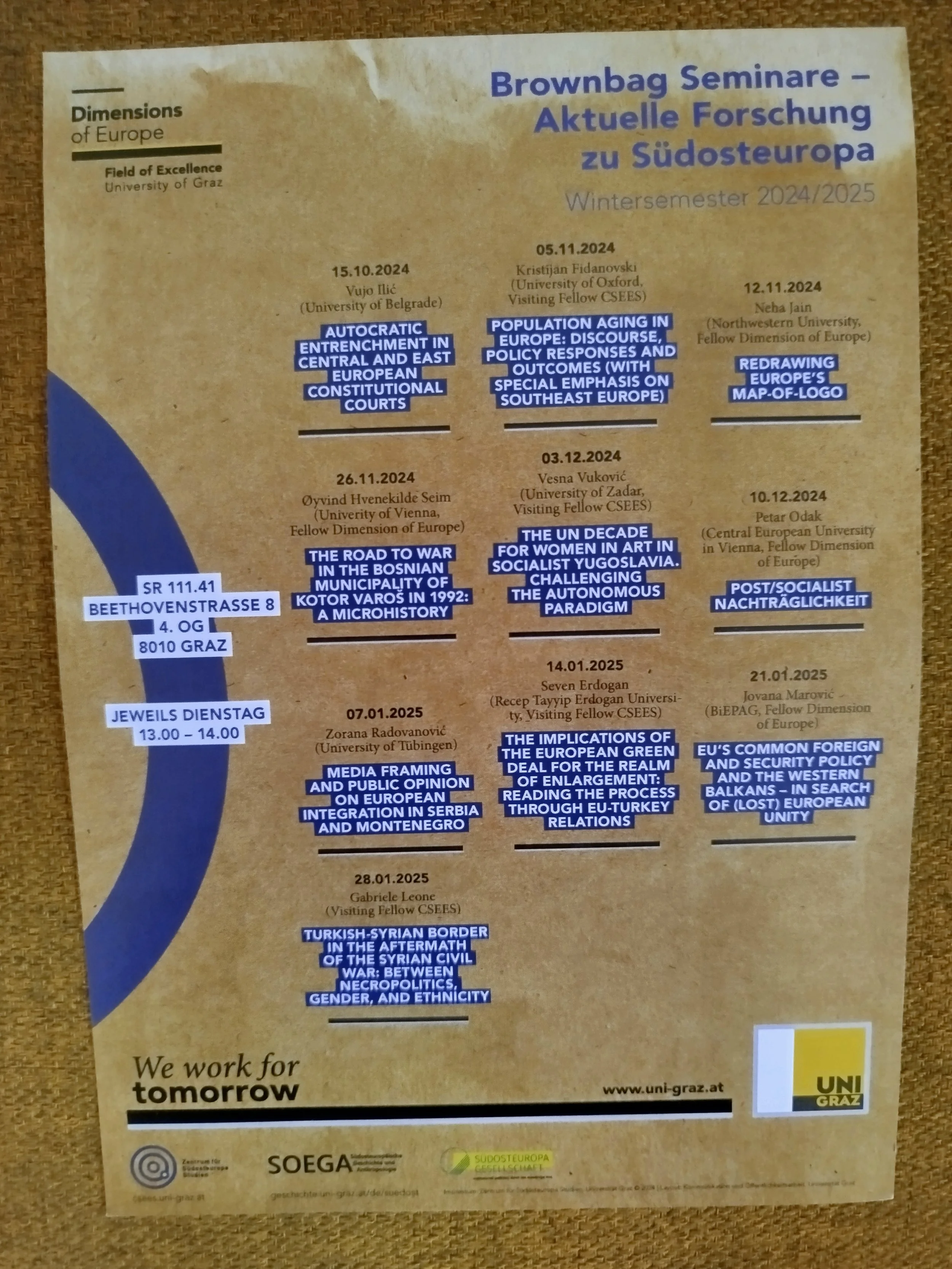
Reflections on EU’s slow accession process after lectures at Graz University:
As a visiting fellow to Graz University and CSEES (Centre for Southeast European Studies), Dr. Seim followed two key lectures on EU and the Western Balkans. A takeaway from the lecture of Zorana Radovanović on 7 January 2025 is that public opinion in Serbia is split on EU. This emotional confusion has numerous sources, one of the key issues are media framing, according to Radovanović. While assessing the domestic media as equally split, Radovanović pinpointed to the need for EU to apply better rhetorical tactics, for instance to better inform about EU being the biggest donor in Serbia in comparison to other foreign factors (e.g. China or Russia).
In her lecture on 21 January 2025, Jovana Marović (who has background as Deputy Prime Minister and Minister of European Affairs of the Government of Montenegro in 2022), explored EU’s Common Foreign and Security Policy (CFSP) and the tensions between national sovereignty and CFSP. Marović explained the ambivalent attempts of Western Balkan countries to fall in line with EUs foreign policy, e.g., towards Russia and Ukraine.
(Photo: The lecture programme of the 2024-25 winter semester)
Key SEIM Analytics Takeaways:
SEIM Analytics finds that reform fatigue, disillusionment, and ambivalent attitudes to EU at the Western Balkans is fully understandable after broken promises of EU membership after the 2003 Thessaloniki Summit and the Stabilization and Association Agreement (SAP), which was only a vaguer, more conditional version of European integration. Indeed, the whole enlargement process of the European Unity on the Balkans has had numerous contradictory traits and EU’s credibility is at stake.
· Including Bulgaria and Romania in 2007, was clearly a geopolitical decision, and their late Schengen inclusion demonstrates this. These countries were not particularly better positioned than the Western Balkans countries, but were treated differently based on geopolitical motives. After their “easy” accession, EU has been applying changing and expanding criteria, making it difficult for candidate countries to meet standards, also/even when aligning legislation.
· Serbia is pressured for not aligning with EU sanctions on Russia, while Hungary, being an EU member, has much more leeway. Demands on accession countries to align with the EU Common Foreign and Security Policy (CFSP) are made, when CFSP is not followed by EU members themselves.
· EU-pressures on Serbia on the Kosovo issue are coercive in a manner that undermines Serbia’s national sovereignty and democratic legitimacy.
· EU’s Kosovo approach has been counterproductive. The lacking pressures on Priština, in particular on the issue of establishing a functional and strengthened Community of Serb Municipalities in Kosovo (within the Republic of Serbia) has hindered normalization in their relations and minimized Serbia’s room for political manoeuvring. EU-enlargement is framed as a technical process, but the demanded dialogue between Serbia and Priština is an obstacle that is deeply political. Here, the power asymmetry due to the continued NATO-occupation of Kosovo hinders normalization as Priština is not pressured into agreements by Germany, for instance.
- The inclusion of Croatia and Bulgaria before key issues with their non-EU neighbours were solved was also a mistake. North Macedonia was blocked by Bulgaria after solving its disputes with Greece. Meanwhile, Croatia has not adequately faced its war crimes and expulsion of the Croatian Serbs in the 1990s, also not properly dealt with its past war crimes and attempted genocide on Serbs, Jews, and Roma on the NDH (Ustasha pro-Nazi fascist state 1941-45) in World War 2. An unacceptable anti-Serbian and pro-fascist iconography can still be seen in Croatia, (e.g. at the concerts of Marko Perković Thompson in Zagreb Hippodrom on 5 July, the biggest concert event in Europe in 2025 with more than 500.000 attendees).
- Currently, Croatia can blackmail Serbia on the issue about the disputed Danube islands, while Bulgaria is blackmailing North Macedonia on language and identity issues. This blackmailing shows that both countries do not uphold core EU values. Instead, EU should pressure both these two EU members to accept rational and fair solutions on these bilateral matters which would help the aspiring EU-members in joining EU. Turning a blind eye to this misuse of their EU status is impacting the credibility of EU in the public opinion of these candidate countries. It is against the EU spirit. In the midst of this, EU is inventing new accession criteria and new models about EU accession with “probation periods” and no voting rights.
- The slow progress being made in the candidate countries is also related to domestic deficits in dealing with corruption and crime. Yet, the increasing EU conditionality is counterproductive as some issues that the EU candidate countries must solve are best achieved with EU membership when getting access to appropriate resources. There is a greater risk of not fully including the Western Balkans than of including the region.
- The slow progress towards EU can renew potential ethnic tensions on the Western Balkans as the technocratic EU approach to difficult state sovereignty question on the Western Balkans avoids addressing political conflicts.
- Also the Balkans are pressured into a dysfunctional energy market by Germany: The mistaken German policies related to its own energy transition has impacted Europe’s energy market and periodically made it dysfunctional, both with consequences in Southern Scandinavia and in Central and Southeast Europe. Here, critique of EU and Germany is legitimate. Also, it was Germany that blocked South Stream in order to make Gazprom invest in North Stream to benefit German industry instead, also detrimental to Southeast Europe, but eventually this self-centred German strategy boomeranged back on Germany.
The topic about problematic EU policies towards the Balkans cannot be exhausted here, but will remain a key topic followed by SEIM Analytics in future blog articles and reports: Stay tuned !
See also the following conference report on Europe’s Future.