
The Spring Seminar of the Vienna Institute of International Economic Studies (WIIW)
6 June 2025
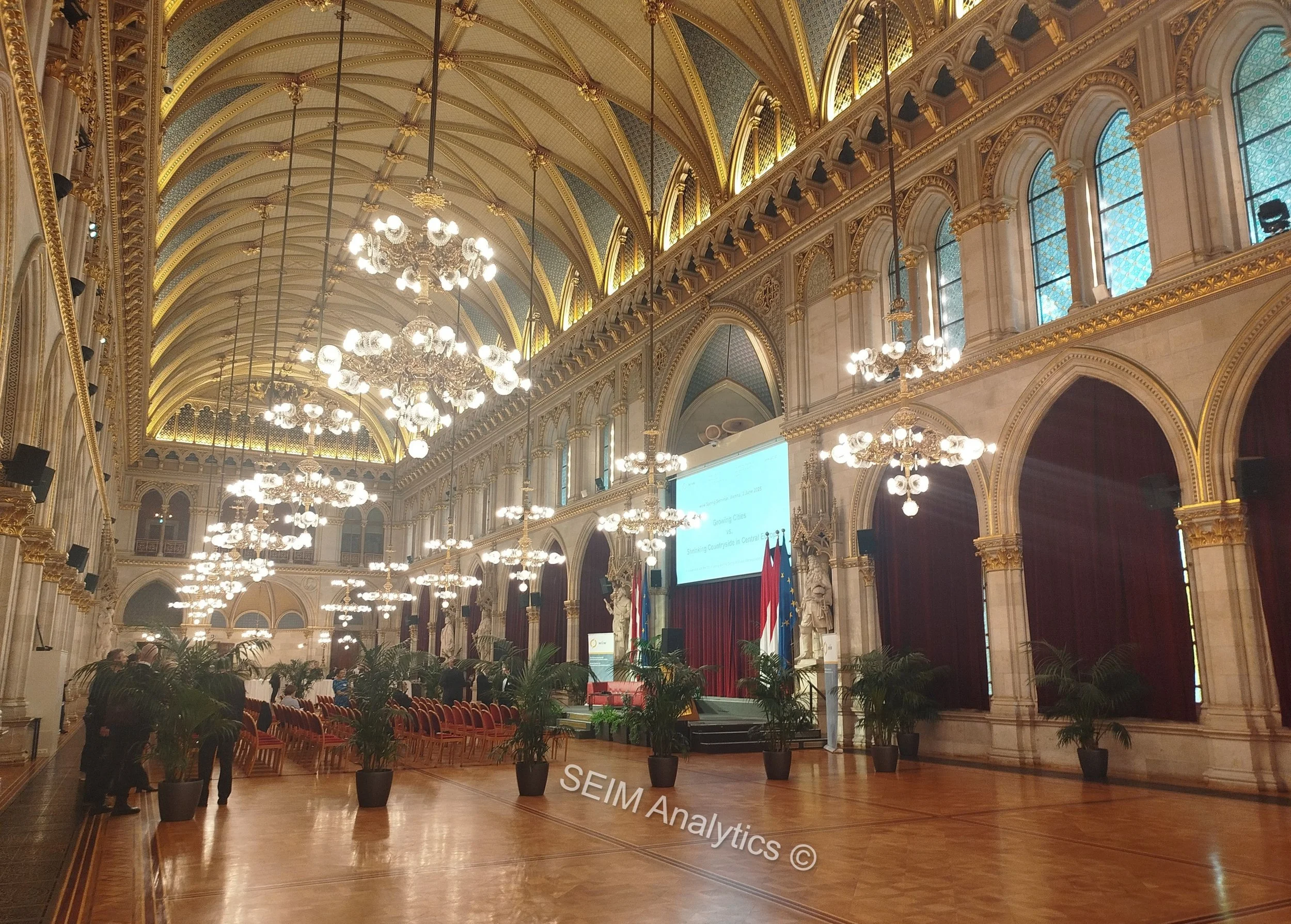
SEIM Analytics participated at the Spring Seminar of the Vienna Institute of International Economic Studies (WIIW) that this year took place in the magnificence of the Vienna City Hall (Festsaal). The title of this years’ conference was Growing Cities vs. Shrinking Countryside in Central Europe. A key speaker was geography professor, Andres Rodriguez-Pose, from London School of Economics, who spoke about the link between Euroscepticism and unequal urban/rural growth.
With the continuous emptying and demographical shrinkage of the countryside and flight to the cities in most of Eastern Europe but also Central Europe, this conference topic is in line with SEIM Analytics past and ongoing research projects, among other on social inequalities and rural-urban developmental path dependencies, including its link to nationalist mobilization ahead of the civil war in Bosnia in 1992. The subject matter has political implications and can help explain Euroscepticism in contemporary election patterns, as SEIM pinpointed at the event, yet disagreeing to some degree with the key speaker on the issue being a socio-economic one about unequal development (that can be met with even more of EU’s cohesion policies, as suggested by speakers) or if it is more about voters being offended by cultural policies, as this report will return to.
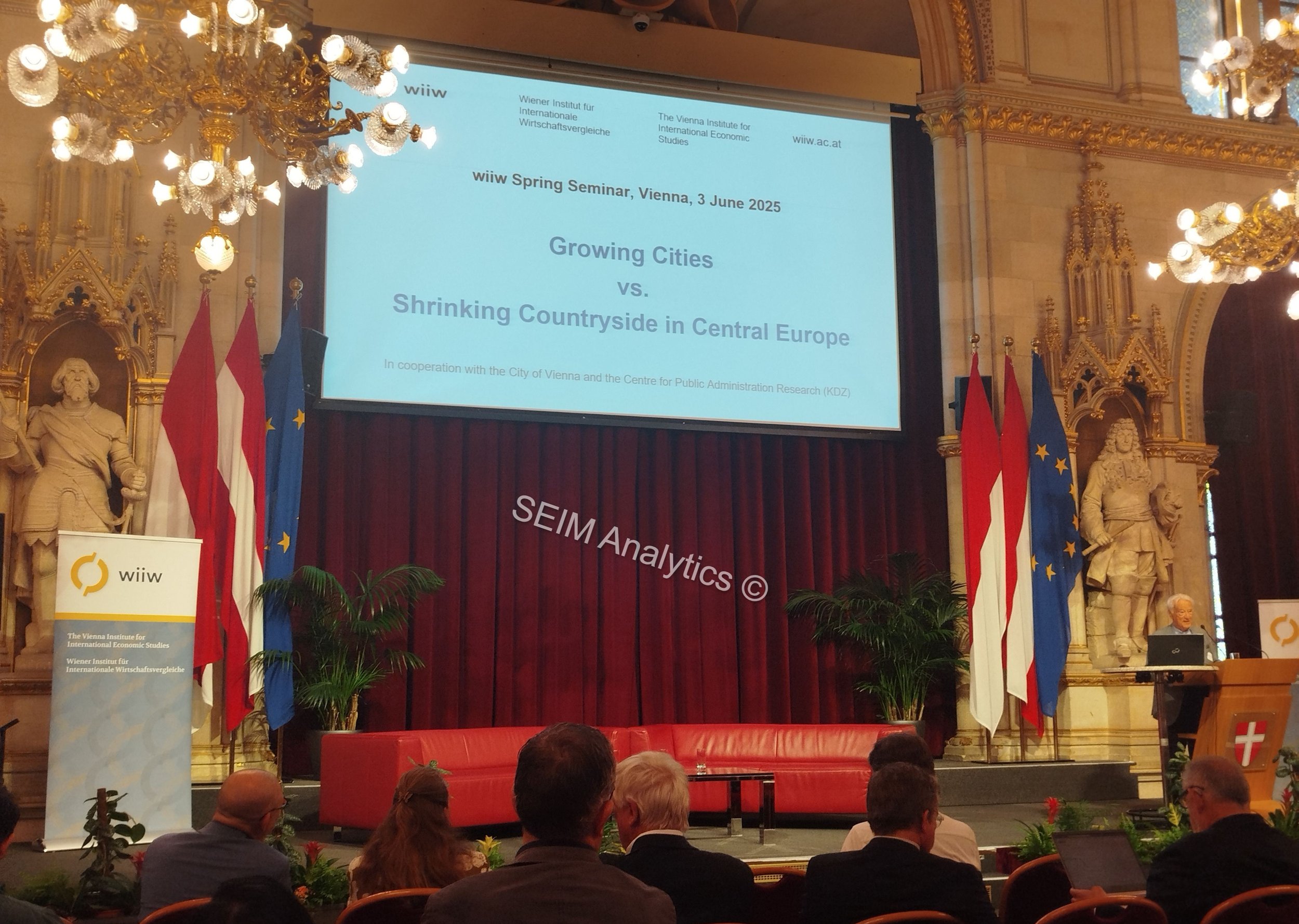
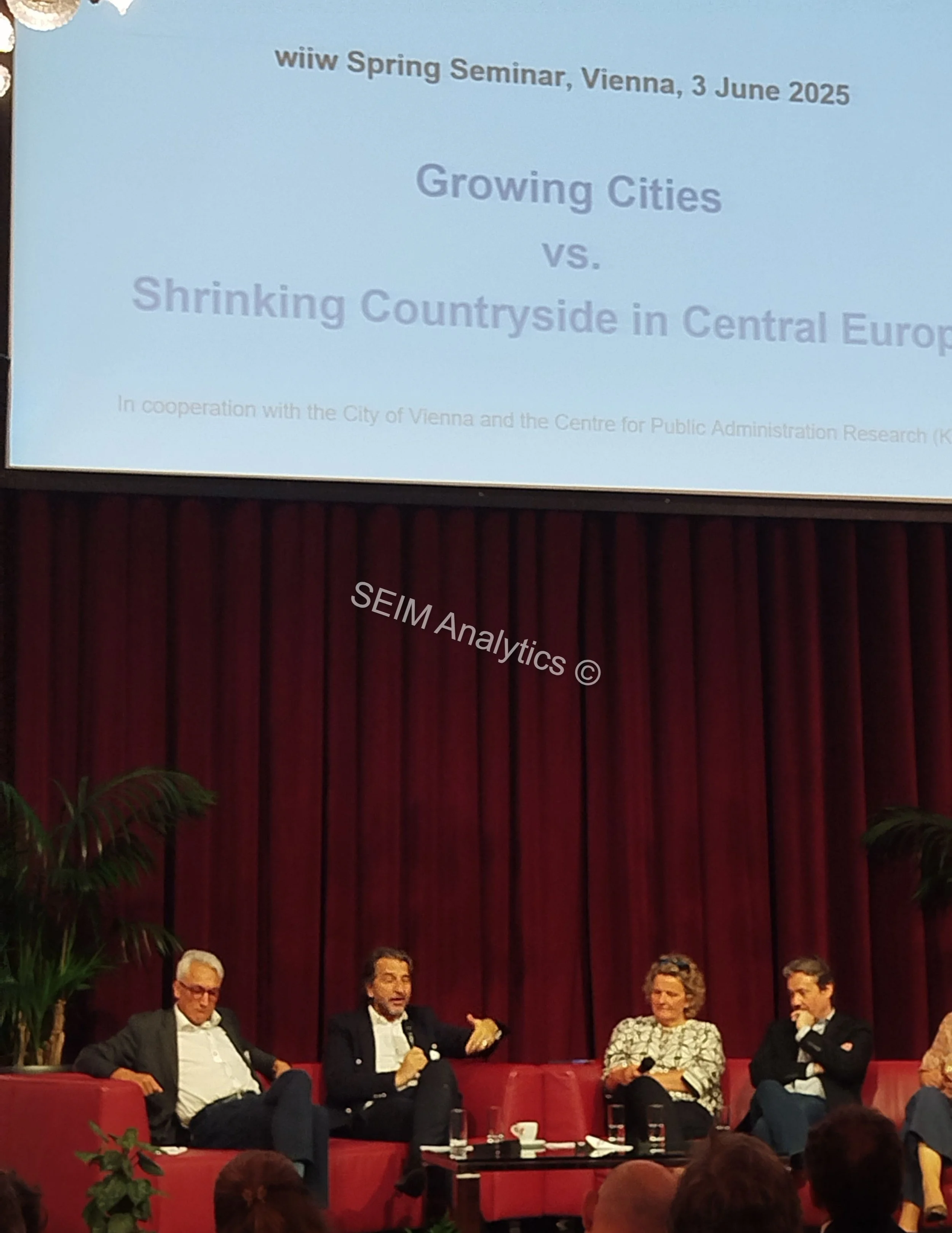
Among other interesting speakers were Alexandra Sandu from the University of Cardiff, School of Geography and Urban Planning, who with examples from Romania (like land-use patterns in Brasov) discussed the fast-shrinking rural countryside and urban sprawls, leading to a fractures urban landscape. Another interesting speaker was Dubravko Bilić, the mayor of Ludbreg by Varaždin, who discussed the stagnation of his town, partly related to bad privatization in the 1990s, but also deeper structural traits and the lack of local visions. A general problem in Croatia is the lack of administrative reform with many small unsustainable municipalities. The mayor of Priština problematized that the city’s rather insufficiently organized growth has not been matched by a strengthening of the public sector, as also witnessed by Dr. SEIM in a fieldtrip to Priština and Prizren in February 2025.
Also to be mentioned were speeches and moderation by WIIW director, Mario Holzner, and of Peter Wieser, Head of the City of Vienna Municipal Department for Economic Affairs, Labour and Statistics (MA-23). Of particular interest was the WIIW forecasts for Central, East, and Southeast Europe report, presented by deputy director Richard Grieveson. See WIIW publications here
WIIW is key to comparative research on the transition, EU integration, and economic developments of Eastern and Southeastern Europe, SEIM Analytics’ targeted focus. WIIW possesses and applies rich and continuously updated databases relevant for macroeconomic analysis. It regularly publishes economic analysis, research, and forecasts both to clients and to the interested public.
SEIM Analytics assessment > The cultural factor and election patterns: socio-economic v. the cultural factor. Is EU’s cohesion fund the right answer?
The rapid post-communist economic transformation in most of Central and Eastern Europe have led to two-speed societies with an intertwined rural-urban component. The argument made by many analysts and international newspapers, and as discussed and seemingly argued for by Andres Rodriguez-Pose is that the socio-economic and urban-rural differences in this two-speed developmental trajectory can explain election patterns and the right-wing or populist Eurosceptic turn.
A question raised by SEIM after the illuminating keynote speech of Dr. Rodriguez-Pose is if regional and rural-urban socio-economic disparities is a perspective that can fully or solely these contemporary political patterns in particular in Eastern/Central Europe, for instance as seen in the presidential election in Romania and Poland this spring, or if one also must look at the cultural factor and the flattening out of real-life maps by social media.
SEIM Analytics judges that there also is a cultural battle unfolding, which only partly correlates to the socio-economic patterns one can observe or map territorially. Inspiration here also comes from abroad, in a subtle manner from the East, and much less subtle from across the Atlantic, which has normalized certain radical discourses. Based on empirical research and election analysis, the approach of SEIM Analytics is that Euroscepticism and the right-wing vote in former communist countries is just as much about urban-rural cultural differences and the cultural clash between urban-liberal v. conservative-national values (religion and traditional family values).
It is also about the information space being dominated by the former, so a perception of cultural marginalization of traditionalist voter groups has developed, differences being amplified but also leading to entrenched social media echo chambers which amplified by manipulative algorithms can trap passive voters in polarized and fragmented information spaces. According to SEIM Analytics, here EU’s economy-and fund-focused cohesion policy is not the direct answer, but rather modifications to and weakening of attempts to define unified cultural policies in European Union, some of which are offensive to voters (among other, too all-encompassing or aggressive LGBTQ policies, and other inclusion/diversity policies).
SEIM Analytics advices that although cultural issues will remain divisive, among solutions to explore is civic education to increase online media literacy, and explain how information/media bubbles and deep fakes function in social media, as well as a refined implementation of EU’s Digital Services Act (DSA) that mandates VLOPs (large online platforms) to proactively mitigate risks to civic discourse, electoral processes, and public security, among other by taking steps to counter inauthentic behaviour on social media. Here DSA must ensure there are no limitations on ordinary* (authentic) citizens’ online political engagement and their ability to make informed choices: as the perception of censorship or restrictions on freedom of expression corrodes trust (and triggers protests votes) just as much as actual violations.
SEIM Analytics on a WIIW related Linkedin discussion> (Click)
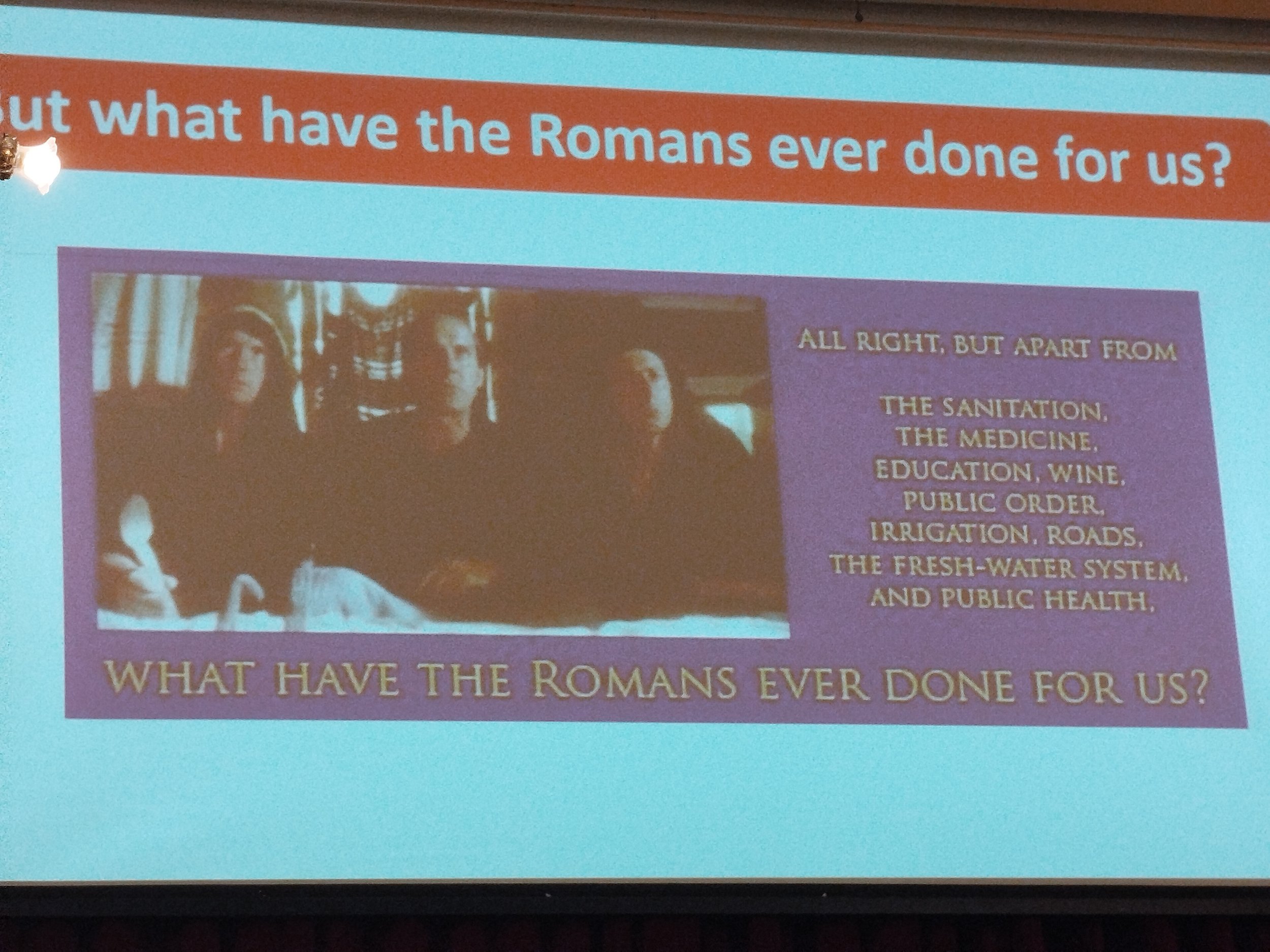
Photo of slide image from the presentation of Dr. Rodriguez-Pose, WIIW spring Conference, 4 June 2025, Vienna. Photo by Øyvind Hvenekilde Seim / SEIM Analytics. Used for documentation and informational purposes only; not for commercial promotion.
The WIIW Spring Seminar program: INVITATION | wiiw Spring Seminar 2025 | 3 June 2025 | Vienna City Hall